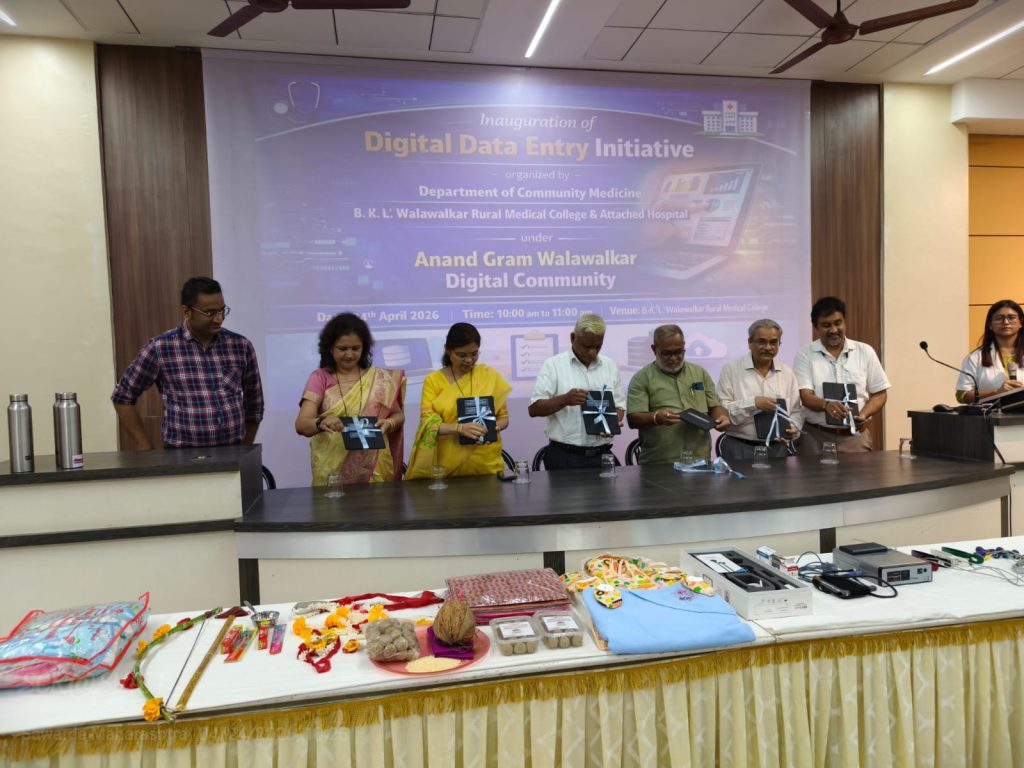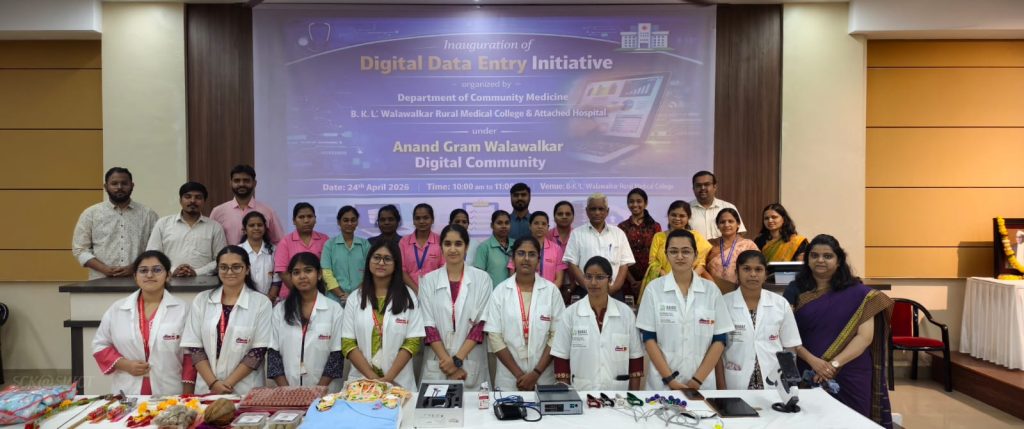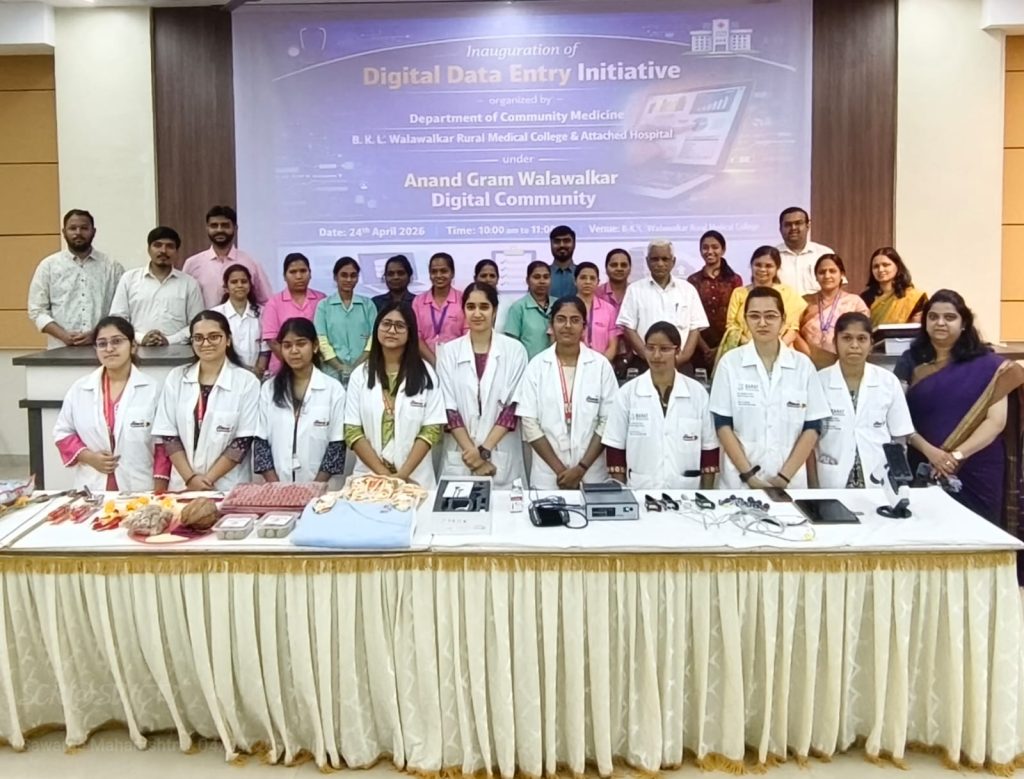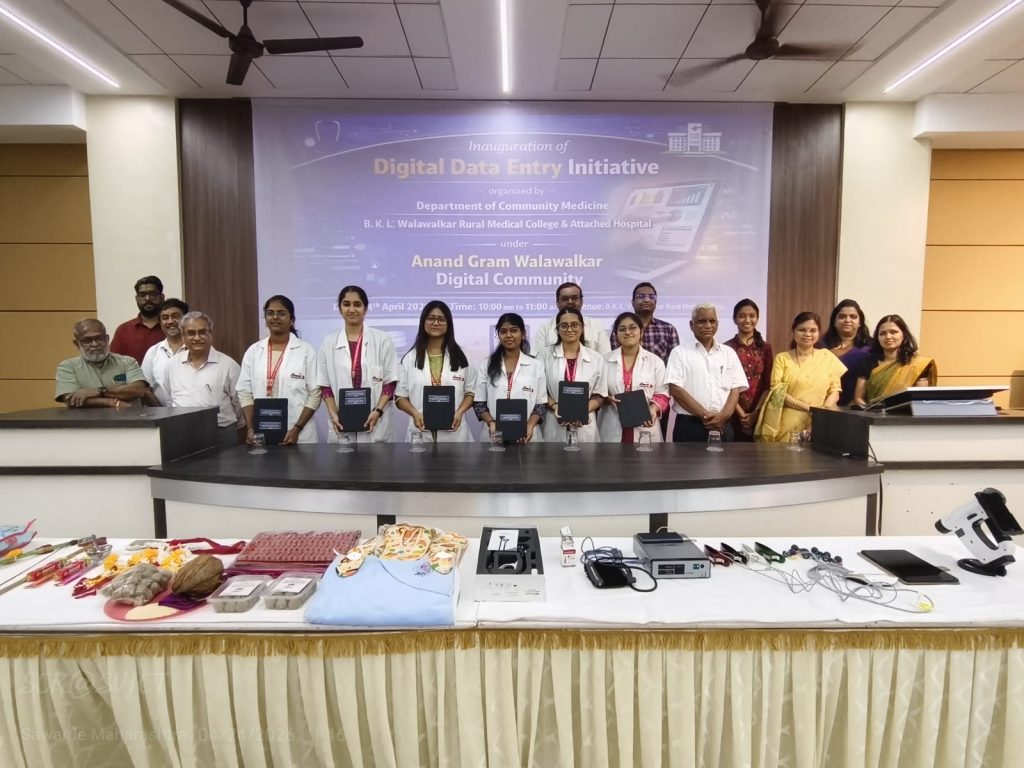
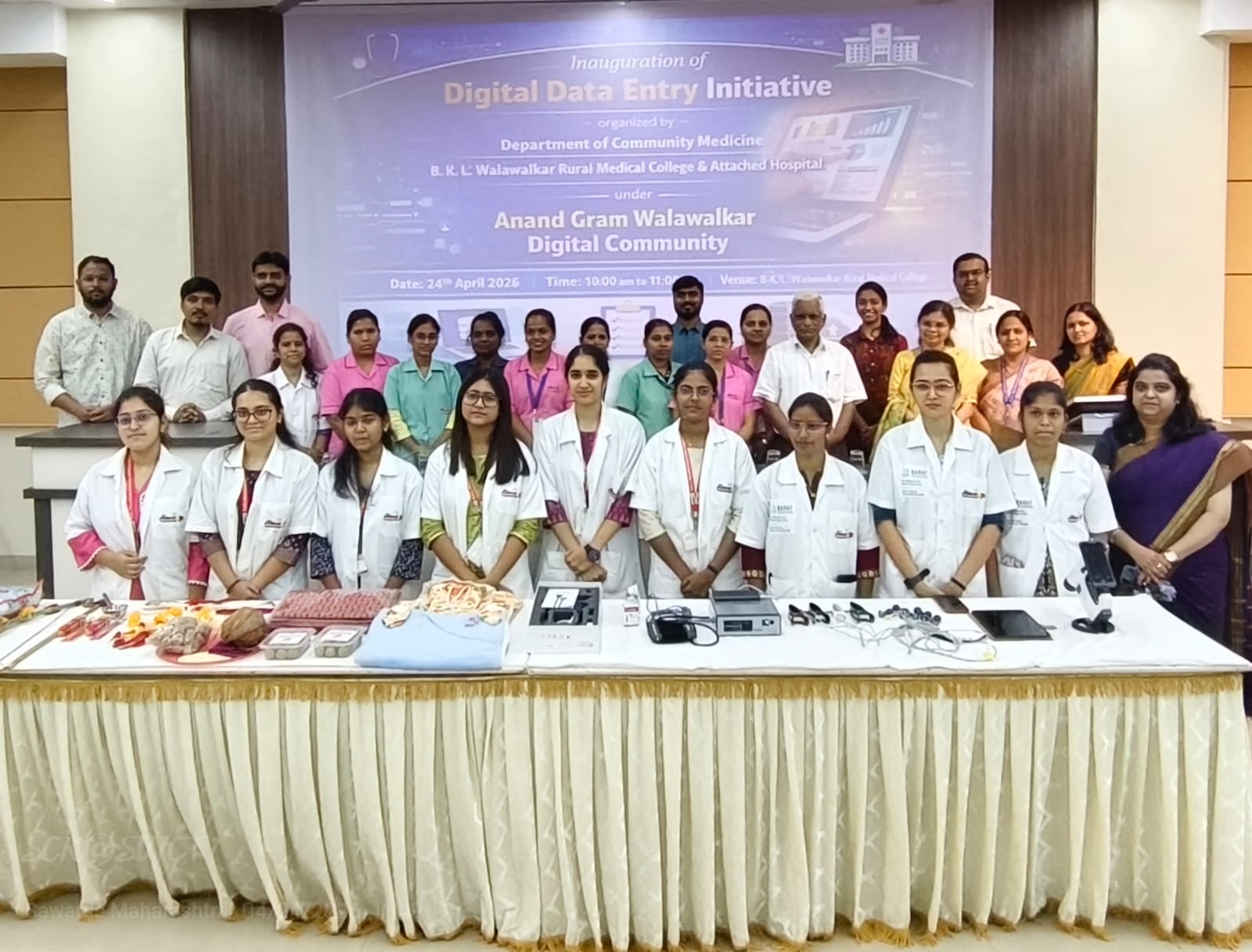
A significant step towards transforming rural healthcare through the integration of technology and compassionate service was marked by the grand launch of the digital data entry initiative under the “Anand Gram Walawalkar Digital Community Program” on 24 April 2026 at B.K.L. Walawalkar Hospital and Rural Medical College, Anil Kakadokar Hall, Dervan. The event was not merely a formal inauguration, but the beginning of a subtle yet impactful revolution in the rural healthcare system.
The program commenced with the traditional lighting of the lamp, symbolizing knowledge, positivity, and progress. The occasion was graced by the esteemed presence of Medical Director Dr. Suvarna Patil, Dean Dr. Mansingrao Ghatge, Dr. Anagha Modak, Physiotherapy Principal Dr. Chandrashekhar, and Head of the Department of Community Medicine Dr. Gajanan Velhal. Their presence and guidance added immense value and inspiration to the initiative.
The program witnessed active participation from 17 faculty members, 215 MBBS students, and 4 postgraduate students, reflecting a strong collective commitment towards community healthcare advancement.
A central message emphasized during the event was that a patient is not merely a diagnosis or a disease, but represents a story, a family, and a journey of struggle. For years, healthcare teams have reached remote villages to deliver essential services; however, documentation remained largely paper-based, often vulnerable to damage or loss over time. This initiative aims to digitize such records, ensuring they are secure, accurate, and easily accessible for improved healthcare delivery.
Established under the visionary leadership of Shri Vitthalrao Joshi Charities Trust, the institution stands as more than just a healthcare facility—it represents a social movement. Since its inception in 1996 and the establishment of the medical college in 2015, the institution has significantly contributed to improving the quality of life in rural communities. It continues to uphold its guiding principles of “Health for All, Education for All, and Employment for All.”
The program also highlighted several impactful community initiatives. The Ladoo Gopal Scheme focuses on combating malnutrition, while the Yashoda and Maher schemes support maternal health. The Dental Care Scheme promotes oral hygiene and aids in cancer prevention awareness. Additionally, the Sudama, Sukanya, and Balram schemes contribute to education, women empowerment, and child development. These initiatives collectively serve as pillars of hope for many families.
One of the most notable moments of the event was the launch of tablets for digital data entry. This milestone signifies not just the adoption of modern technology, but also a commitment to preserving years of dedicated service while paving the way for a more efficient and structured healthcare system. Real-time recording of patient data will enhance planning, monitoring, and delivery of healthcare services.
Dr. Gajanan Velhal, Head of Community Medicine, provided valuable insights into the ‘CAR Rahat Project,’ emphasizing the role of digital tools in strengthening rural healthcare infrastructure. In her address, Medical Director Dr. Suvarna Patil encouraged students to engage in research, underscored the importance of rural outreach, and highlighted effective communication skills as essential for future healthcare professionals. She also shared a forward-looking vision of elevating such initiatives to global standards.
The program concluded with a vote of thanks, leaving behind a strong sense of purpose and optimism. It was evident that this initiative marks not an end, but the beginning of a transformative journey. Moving forward, this effort is expected to create a meaningful impact across villages, health camps, and individual lives—because every data entry represents not just information, but a human story, and every life holds immense value.
Psychiatrists Dr. Swati Sonawane and Dr. Rupali Chavan have been making a valuable and sustained contribution for several years.
Owing to the impact of these effective initiatives, several prestigious government institutions such as the Indian Council of Medical Research (ICMR), the Tata Institute of Fundamental Research (TIFR), and CCDC, Delhi have extended their support. Through this collaboration, many innovative programs have been planned and implemented to strengthen the rural healthcare revolution, further reinforcing trust in Walawalkar Hospital.