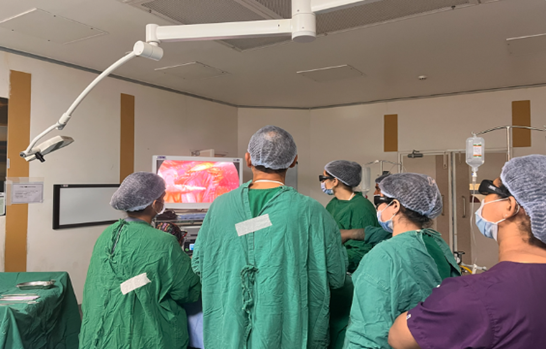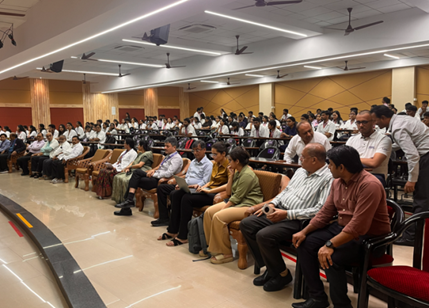
The field of minimally invasive gynaecological surgery is constantly evolving, requiring not only technical skills but also a profound understanding of surgical anatomical relationships. Recently, my colleague Dr. Ashish Parulekar and I had the privilege of participating in a remarkable academic and surgical experience at B.K.L. Walawalkar Hospital, where, together with an exceptional team, we performed a series of complex laparoscopic procedures on a soft-embalmed female cadaver, a novel technique developed in-house by Dr. Prashant Moollya and his dedicated team.
This innovative preservation method bridges the gap between fresh cadavers and traditionally embalmed ones, providing near-live tissue texture and colour. The soft-embalmed model offers a realistic dissection experience and mimics actual surgical conditions with impressive accuracy, making it ideal for teaching advanced endoscopic anatomy and operative finesse.
Our team, including Dr. Mrinalini Agrawal, Dr. Mitali Sharma, and Dr. Mahima Maniar, devised a structured dissection plan to ensure each cadaver was utilized to its fullest educational potential. Various gynaecological endoscopic procedures were demonstrated, focusing on laparoscopic entry techniques, retroperitoneal and retropubic space dissections, and identification of deep pelvic nerves and vascular landmarks. Using both sharp and energy-based instruments, we emphasized tissue respect, nerve-sparing dissection, and the fine motor precision essential for improving surgical outcomes.
The program was structured to move seamlessly from theory to hands-on practice. We began with an interactive lecture on “Surgical Techniques in Common Gynecological Endoscopic Procedures,” followed by guided cadaveric dissection. Participantsincluding postgraduate trainees, interns, undergraduate students and faculty members transitioned from observation to active engagement, gaining confidence with every layer they dissected. The experience helped them appreciate the intricate spatial relationships within the pelvis and understand how each structure interacts within the limited two-dimensional laparoscopic field.
The integration of high-definition imaging and advanced ultrasonic energy platforms, made possible by the support of Karl Storz and Johnson and Johnson, added another dimension to learning. The clarity, magnification, and colour accuracy of modern systems allowed participants to visualize delicate tissue planes and subtle vascular variations with remarkable accuracy. Working in a cadaveric setup provided a safe space to experiment, refine movements, and learn from mistakes a vital step before applying these skills in live surgery.
What truly set this workshop apart was the collaborative spirit and academic enthusiasm of the entire BKL Walawalkar Hospital team. The Department of Obstetrics and Gynecology, led by Dr. Sanjay Patil (HOD), has been exemplary in promoting advanced surgical skill training. Special appreciation goes to Dr. Suvarna Patil, Dr. Raksha Shetty, and Dr. Netaji Patil, whose organization and encouragement made the event a success. The enthusiasm of students like Dr. Mrugraj Marchande added infectious energy to the sessions.
The hospital also arranged a live surgical workshop, coordinated with the anaesthesia team led by Dr. Leena Thakur and the nursing staff. This provided an excellent opportunity to translate cadaveric learnings into clinical application, reinforcing the principles demonstrated in the lab.
Experiences like these remind us that while technology continues to evolve, the foundation of surgical excellence lies in education, mentorship, and anatomical mastery. The soft-embalmed cadaveric model offers the most realistic environment for laparoscopic training bridging the gap between virtual simulation and live surgery, and nurturing the next generation of confident, safe, and skilled surgeons.
My heartfelt gratitude to the entire team at B.K.L. Walawalkar Hospital for their unwavering commitment to surgical education. This program was not just a training exercise it was a celebration of innovation, teamwork, and shared learning that truly pushes the boundaries of gynaecological endoscopy in India.
Expert Faculty Mentoring Delegates during Every Aspiring Gynaecologist Learners Endoscopy (EAGLE) Workshop:
· Dr. Sanjay Patil, Prof and HOD OBGY, BKLWRMC
· Dr. Balaji Reddy, Jahangir Hospital, Pune
· Dr. Krishna Mandade, Asso. Prof. OBGY, Advanced Laparoscopist, Latur
· Dr. Raju Parulekar, Mumbai
· Dr. Vijay Satale, Pune